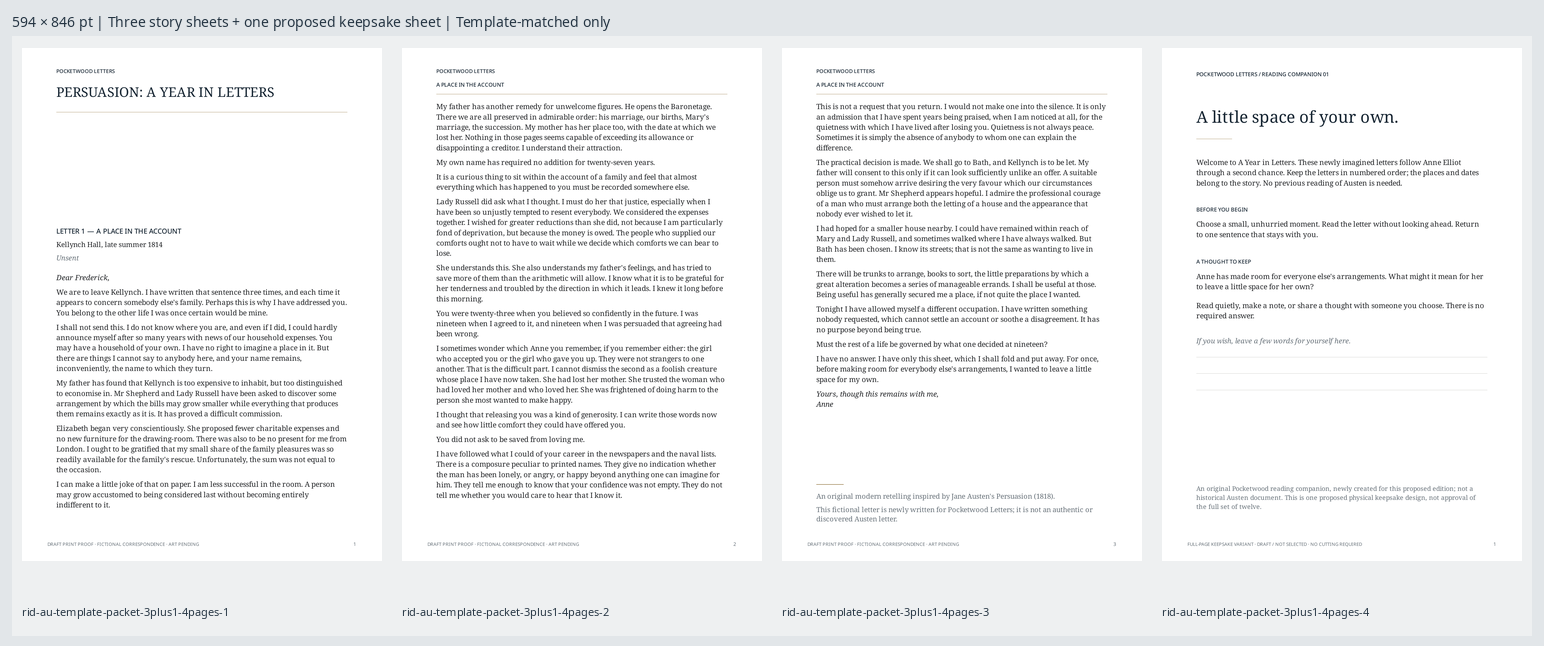
Dear Frederick,
We are to leave Kellynch. I have written that sentence three times, and each time it appears to concern somebody else's family. Perhaps this is why I have addressed you. You belong to the other life I was once certain would be mine.
I shall not send this. I do not know where you are, and even if I did, I could hardly announce myself after so many years with news of our household expenses. You may have a household of your own. I have no right to imagine a place in it. But there are things I cannot say to anybody here, and your name remains, inconveniently, the name to which they turn.
My father has found that Kellynch is too expensive to inhabit, but too distinguished to economise in. Mr Shepherd and Lady Russell have been asked to discover some arrangement by which the bills may grow smaller while everything that produces them remains exactly as it is. It has proved a difficult commission.
Elizabeth began very conscientiously. She proposed fewer charitable expenses and no new furniture for the drawing-room. There was also to be no present for me from London. I ought to be gratified that my small share of the family pleasures was so readily available for the family's rescue. Unfortunately, the sum was not equal to the occasion.
I can make a little joke of that on paper. I am less successful in the room. A person may grow accustomed to being considered last without becoming entirely indifferent to it.
My father has another remedy for unwelcome figures. He opens the Baronetage. There we are all preserved in admirable order: his marriage, our births, Mary's marriage, the succession. My mother has her place too, with the date at which we lost her. Nothing in those pages seems capable of exceeding its allowance or disappointing a creditor. I understand their attraction.
My own name has required no addition for twenty-seven years.
It is a curious thing to sit within the account of a family and feel that almost everything which has happened to you must be recorded somewhere else.
Lady Russell did ask what I thought. I must do her that justice, especially when I have been so unjustly tempted to resent everybody. We considered the expenses together. I wished for greater reductions than she did, not because I am particularly fond of deprivation, but because the money is owed. The people who supplied our comforts ought not to have to wait while we decide which comforts we can bear to lose.
She understands this. She also understands my father's feelings, and has tried to save more of them than the arithmetic will allow. I know what it is to be grateful for her tenderness and troubled by the direction in which it leads. I knew it long before this morning.
You were twenty-three when you believed so confidently in the future. I was nineteen when I agreed to it, and nineteen when I was persuaded that agreeing had been wrong.
I sometimes wonder which Anne you remember, if you remember either: the girl who accepted you or the girl who gave you up. They were not strangers to one another. That is the difficult part. I cannot dismiss the second as a foolish creature whose place I have now taken. She had lost her mother. She trusted the woman who had loved her mother and who loved her. She was frightened of doing harm to the person she most wanted to make happy.
I thought that releasing you was a kind of generosity. I can write those words now and see how little comfort they could have offered you.
You did not ask to be saved from loving me.
I have followed what I could of your career in the newspapers and the naval lists. There is a composure peculiar to printed names. They give no indication whether the man has been lonely, or angry, or happy beyond anything one can imagine for him. They tell me enough to know that your confidence was not empty. They do not tell me whether you would care to hear that I know it.
This is not a request that you return. I would not make one into the silence. It is only an admission that I have spent years being praised, when I am noticed at all, for the quietness with which I have lived after losing you. Quietness is not always peace. Sometimes it is simply the absence of anybody to whom one can explain the difference.
The practical decision is made. We shall go to Bath, and Kellynch is to be let. My father will consent to this only if it can look sufficiently unlike an offer. A suitable person must somehow arrive desiring the very favour which our circumstances oblige us to grant. Mr Shepherd appears hopeful. I admire the professional courage of a man who must arrange both the letting of a house and the appearance that nobody ever wished to let it.
I had hoped for a smaller house nearby. I could have remained within reach of Mary and Lady Russell, and sometimes walked where I have always walked. But Bath has been chosen. I know its streets; that is not the same as wanting to live in them.
There will be trunks to arrange, books to sort, the little preparations by which a great alteration becomes a series of manageable errands. I shall be useful at those. Being useful has generally secured me a place, if not quite the place I wanted.
Tonight I have allowed myself a different occupation. I have written something nobody requested, which cannot settle an account or soothe a disagreement. It has no purpose beyond being true.
Must the rest of a life be governed by what one decided at nineteen?
I have no answer. I have only this sheet, which I shall fold and put away. For once, before making room for everybody else's arrangements, I wanted to leave a little space for my own.
Yours, though this remains with me,
Anne